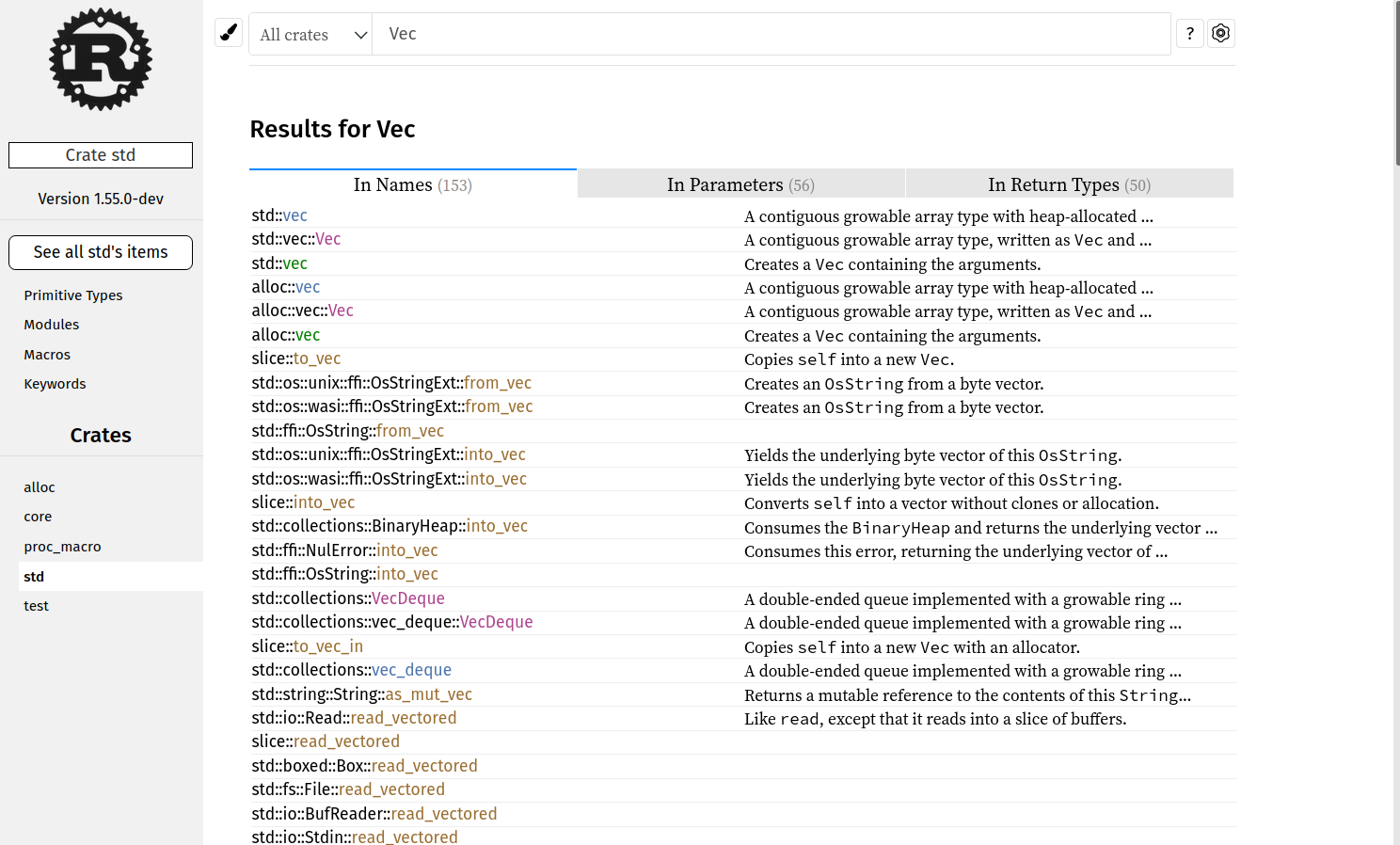
Properly render HRTBs
```rust
pub fn test<T>()
where
for<'a> &'a T: Iterator,
{}
```
This will now render properly including the `for<'a>`

I do not know if this covers all cases, it only covers everything that I could think of that includes `for` and lifetimes in where bounds.
Also someone need to mentor me on how to add a proper rustdoc test for this.
Resolves#78482
refacto use from_def_id_and_attrs_and_parts instead of an old trick

most of josha suggestions + check if def_id is not fake before using it in a query

Removed usage of Attributes in FnDecl and ExternalCrate. Relocate part of the Attributes fields as functions in AttributesExt.
Items are first built after rustdoc creates the TyCtxt. To allow
resolving the links before the TyCtxt is built, the links can't be
stored on `clean::Item` directly.
rustdoc: sort search index items for compression

This should not affect the appearance of the docs pages themselves.

This makes the pre-compressed search index smaller, thanks to the
empty-string path duplication format, and also the gzipped version,
by giving the algorithm more structure to work with.

    rust$ wc -c search-index-old.js search-index-new.js
    2628334 search-index-old.js
    2586181 search-index-new.js
    5214515 total
    rust$ gzip search-index-*
    rust$ wc -c search-index-old.js.gz search-index-new.js.gz
    239486 search-index-old.js.gz
    237386 search-index-new.js.gz
    476872 total
This should not affect the appearance of the docs pages themselves.

This makes the pre-compressed search index smaller, thanks to the
empty-string path duplication format, and also the gzipped version,
by giving the algorithm more structure to work with.

    rust$ wc -c search-index-old.js search-index-new.js
    2628334 search-index-old.js
    2586181 search-index-new.js
    5214515 total
    rust$ gzip search-index-*
    rust$ wc -c search-index-old.js.gz search-index-new.js.gz
    239486 search-index-old.js.gz
    237386 search-index-new.js.gz
    476872 total
rustdoc: Add unstable option to only emit shared/crate-specific files
The intended use case is for docs.rs, which can now copy exactly the
files it cares about, rather than having to guess based on whether they
have a resource suffix or not. In particular, some files have a resource
suffix but cannot be shared between crates: https://github.com/rust-lang/docs.rs/pull/1312#issuecomment-798783688
The end goal is to fixrust-lang/docs.rs#1327 by reverting rust-lang/docs.rs#1324.
This obsoletes `--print=unversioned-files`, which I plan to remove as
soon as docs.rs stops using it.
I recommend reviewing this one commit at a time.
r? ``@GuillaumeGomez`` cc ``@Nemo157`` ``@pietroalbini``
Rename `#[doc(spotlight)]` to `#[doc(notable_trait)]`
Fixes#80936.
"spotlight" is not a very specific or self-explaining name.
Additionally, the dialog that it triggers is called "Notable traits".
So, "notable trait" is a better name.
* Rename `#[doc(spotlight)]` to `#[doc(notable_trait)]`
* Rename `#![feature(doc_spotlight)]` to `#![feature(doc_notable_trait)]`
* Update documentation
* Improve documentation
r? `@Manishearth`
I'm wondering if it was originally there so that we could `take` the
module which enables `after_krate` to take an `&Crate`. However, the two
impls of `after_krate` only use `Crate.name`, so we can pass just the
name instead.
Now that we record the crate's name in its `clean::Item`, pushing the
crate name onto the `stack` causes duplicate paths. E.g., the URL
generated for the path `::foo::bar::baz` would be something like

    ../foo/foo/bar/baz

With this commit, the URL is corrected to

    ../foo/bar/baz
"spotlight" is not a very specific or self-explaining name.
Additionally, the dialog that it triggers is called "Notable traits".
So, "notable trait" is a better name.

* Rename `#[doc(spotlight)]` to `#[doc(notable_trait)]`
* Rename `#![feature(doc_spotlight)]` to `#![feature(doc_notable_trait)]`
* Update documentation
* Improve documentation
Previously, `masked_crates` existed both on `Cache` and on
`clean::Crate`. During cache population, the `clean::Crate` version was
`take`n and moved to `Cache`.

This change removes the version on `clean::Crate` and instead directly
mutates `Cache.masked_crates` to initialize it. This has the advantage
of avoiding duplication and avoiding unnecessary allocation, as well as
making the flow of information through rustdoc less confusing.

The one downside I see is that `clean::utils::krate()` now uses the side
effect of mutating `DocContext.cache` instead of returning the data
directly, but it already mutated the `Cache` for other things (e.g.,
`deref_trait_did`) so it's not really new behavior. Also,
`clean::utils::krate()` is only called once (and is meant to only be
called once since it performs expensive and potentially destructive
operations) so the mutation shouldn't be an issue.
rustdoc: Cleanup `html::render::Context`

- Move most shared fields to `SharedContext` (except for `cache`, which
  isn't mutated anyway)
- Replace a use of `Arc` with `Rc`
- Make a bunch of fields private
- Add static size assertion for `Context`
- Don't share `id_map` and `deref_id_map`
There was no need to clone `id_map` because it was reset before each
item was rendered. `deref_id_map` was not reset, but it was keyed by
`DefId` and thus was unlikely to have collisions (at least for now).

Now we just clone the fields that need to be cloned, and instead create
fresh versions of the others.
Previously, `JsonRenderer::after_krate` called `krate.version.clone()`.
The problem was it did that after the version was already moved into the
cache, so it would always be None. The fix was to get the version from
the cache instead.