Don't print host effect param in pretty `path_generic_args`

Make `own_args_no_defaults` pass back the `GenericParamDef`, so that we can pass both the args *and* param definitions into `path_generic_args`. That allows us to use the `GenericParamDef` to filter out effect params.

This allows us to filter out the host param regardless of whether it's `sym::host` or `true`/`false`.

This also renames a couple of `const_effect_param` -> `host_effect_param`, and restores `~const` pretty printing to `TraitPredPrintModifiersAndPath`.

cc #118785
r? `@fee1-dead` cc `@oli-obk`
Rollup of 5 pull requests

Successful merges:

 - #117966 (add safe compilation options)
 - #118747 (Remove extra check cfg handled by libc directly)
 - #118774 (add test for inductive cycle hangs)
 - #118775 (chore: add test case for type with generic)
 - #118782 (use `&` instead of start-process in x.ps1)

r? `@ghost`
`@rustbot` modify labels: rollup
Don't warn an empty pattern unreachable if we're not sure the data is valid

Exhaustiveness checking used to be naive about the possibility of a place containing invalid data. This could cause it to emit an "unreachable pattern" lint on an arm that was in fact reachable, as in https://github.com/rust-lang/rust/issues/117119.

This PR fixes that. We now track whether a place that is matched on may hold invalid data. This also forced me to be extra precise about how exhaustiveness manages empty types.

Note that this now errs in the opposite direction: the following arm is truly unreachable (because the binding causes a read of the value) but not linted as such. I'd rather not recommend writing a `match ... {}` that has the implicit side-effect of loading the value. [Never patterns](https://github.com/rust-lang/rust/issues/118155) will solve this cleanly.
```rust
match union.value {
    _x => unreachable!(),
}
```

I recommend reviewing commit by commit. I went all-in on the test suite because this went through a lot of iterations and I kept everything. The bit I'm least confident in is `is_known_valid_scrutinee` in `check_match.rs`.

Fixes https://github.com/rust-lang/rust/issues/117119.
add test for inductive cycle hangs

the same pattern is already tested for coinductive cycles, but I now understand the underlying issue and want to make sure we also test it for inductive ones

r? `@compiler-errors`
Strengthen well known check-cfg names and values test

https://github.com/rust-lang/rust/pull/118494 is changing the implementation of how we expect well known check-cfg names and values, but we currently don't have a test that checks every well known only some of them.

This PR therefore strengthen our well known names/values test to include all of the configs to at least avoid unintended regressions and validate new entry.

*this PR also contains some drive-by consolidation of unexpected `target_os`, `target_arch` into a single file*

r? `@nnethercote` (maybe? feel free to re-assign)
Add more SIMD platform-intrinsics

- [x] simd_masked_load
  - [x] LLVM codegen - llvm.masked.load
  - [x] cranelift codegen - implemented but untested
- [ ] simd_masked_store
  - [x] LLVM codegen - llvm.masked.store
  - [ ] cranelift codegen

Also added a run-pass test to test both intrinsics, and additional build-fail & check-fail to cover validation for both intrinsics
as they unnecessarily clutter the diagnostic output and make the
experience of adding a new target to the compiler more painful than
it should be.

target_os and target_arch are still being tested in the
well-known-values.rs test, but in one place.
Make async generators fused by default

I actually changed my mind about this since the implementation PR landed. I think it's beneficial for `async gen` blocks to be "fused" by default -- i.e., for them to repeatedly return `Poll::Ready(None)` -- rather than panic.

We have [`FusedStream`](https://docs.rs/futures/latest/futures/stream/trait.FusedStream.html) in futures-rs to represent streams with this capability already anyways.

r? eholk
cc ```@rust-lang/wg-async,``` would like to know if anyone else has opinions about this.
coverage: Simplify the heuristic for ignoring `async fn` return spans

The code for extracting coverage spans from MIR has a special heuristic for dealing with `async fn`, so that the function's closing brace does not have a confusing double count.

The code implementing that heuristic is currently mixed in with the code for flushing remaining spans after the main refinement loop, making the refinement code harder to understand.

We can solve that by hoisting the heuristic to an earlier stage, after the spans have been extracted and sorted but before they have been processed by the refinement loop.

The coverage tests verify that the heuristic is still effective, so coverage mappings/reports for `async fn` have not changed.

---

This PR also has the side-effect of fixing the `None some_prev` panic that started appearing after #118525.

The old code assumed that `prev` would always be present after the refinement loop. That was only true if the list of collected spans was non-empty, but prior to #118525 that didn't seem to come up in practice. After that change, the list of collected spans could be empty in some specific circumstances, leading to panics.

The new code uses an `if let` to inspect `prev`, which correctly does nothing if there is no span present.
update target feature following LLVM API change

LLVM commit e817966718 renamed* the `unaligned-scalar-mem` target feature to `fast-unaligned-access`.

(*) technically the commit folded two previous features into one, but there are no references to the other one in rust.
Add tests related to normalization in implied bounds

Getting ```@aliemjay's``` tests from #109763, so we can better track what's going on in every different example.

r? ```@jackh726```
coverage: Use `SpanMarker` to improve coverage spans for `if !` expressions
Coverage instrumentation works by extracting source code spans from MIR. However, some kinds of syntax are effectively erased during MIR building, so their spans don't necessarily exist anywhere in MIR, making them invisible to the coverage instrumentor (unless we resort to various heuristics and hacks to recover them).
This PR introduces `CoverageKind::SpanMarker`, which is a new variant of `StatementKind::Coverage`. Its sole purpose is to represent spans that would otherwise not appear in MIR, so that the coverage instrumentor can extract them.
When coverage is enabled, the MIR builder can insert these dummy statements as needed, to improve the accuracy of spans used by coverage mappings.
Fixes#115468.
---
```@rustbot``` label +A-code-coverage
temporarily revert "ice on ambguity in mir typeck"
Reverts #116530 as a temporary measure to fix#117577. That issue should be ultimately fixed by checking WF of type annotations prior to normalization, which is implemented in #104098 but this PR is intended to be backported to beta.
r? ``@compiler-errors`` (the reviewer of the reverted PR)
recurse into refs when comparing tys for diagnostics
before:

after:
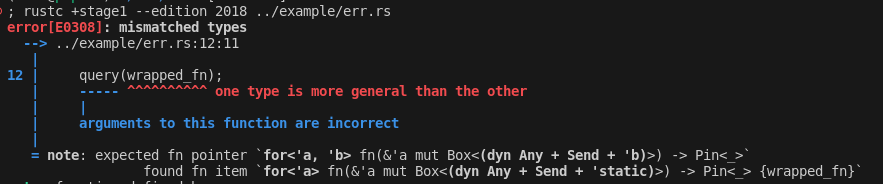
this diff from the test suite is also quite nice imo:
```diff
`@@` -4,8 +4,8 `@@` error[E0308]: mismatched types
LL | debug_assert_eq!(iter.next(), Some(value));
| ^^^^^^^^^^^ expected `Option<<I as Iterator>::Item>`, found `Option<&<I as Iterator>::Item>`
|
- = note: expected enum `Option<<I as Iterator>::Item>`
- found enum `Option<&<I as Iterator>::Item>`
+ = note: expected enum `Option<_>`
+ found enum `Option<&_>`
```
privacy: visit trait def id of projections
Fixes#117997.
A refactoring in #117076 changed the `DefIdVisitorSkeleton` to avoid calling `visit_projection_ty` for `ty::Projection` aliases, and instead just iterate over the args - this makes sense, as `visit_projection_ty` will indirectly visit all of the same args, but in doing so, will also create a `TraitRef` containing the trait's `DefId`, which also gets visited. The trait's `DefId` isn't visited when we only visit the arguments without separating them into `TraitRef` and own args first.
Eventually this influences the reachability set and whether a function is encoded into the metadata.
Add instance evaluation and methods to read an allocation in StableMIR

The instance evaluation is needed to handle intrinsics such as `type_id` and `type_name`.

Since we now use Allocation to represent all evaluated constants, provide a few methods to help process the data inside an allocation.

I've also started to add a structured way to get information about the compilation target machine. For now, I've only added information needed to process an allocation.

r? ``````@ouz-a``````
Introduce support for `async gen` blocks

I'm delighted to demonstrate that `async gen` block are not very difficult to support. They're simply coroutines that yield `Poll<Option<T>>` and return `()`.

**This PR is WIP and in draft mode for now** -- I'm mostly putting it up to show folks that it's possible. This PR needs a lang-team experiment associated with it or possible an RFC, since I don't think it falls under the jurisdiction of the `gen` RFC that was recently authored by oli (https://github.com/rust-lang/rfcs/pull/3513, https://github.com/rust-lang/rust/issues/117078).

### Technical note on the pre-generator-transform yield type:

The reason that the underlying coroutines yield `Poll<Option<T>>` and not `Poll<T>` (which would make more sense, IMO, for the pre-transformed coroutine), is because the `TransformVisitor` that is used to turn coroutines into built-in state machine functions would have to destructure and reconstruct the latter into the former, which requires at least inserting a new basic block (for a `switchInt` terminator, to match on the `Poll` discriminant).

This does mean that the desugaring (at the `rustc_ast_lowering` level) of `async gen` blocks is a bit more involved. However, since we already need to intercept both `.await` and `yield` operators, I don't consider it much of a technical burden.

r? `@ghost`
never_patterns: Parse match arms with no body

Never patterns are meant to signal unreachable cases, and thus don't take bodies:
```rust
let ptr: *const Option<!> = ...;
match *ptr {
    None => { foo(); }
    Some(!),
}
```
This PR makes rustc accept the above, and enforces that an arm has a body xor is a never pattern. This affects parsing of match arms even with the feature off, so this is delicate. (Plus this is my first non-trivial change to the parser).

~~The last commit is optional; it introduces a bit of churn to allow the new suggestions to be machine-applicable. There may be a better solution? I'm not sure.~~ EDIT: I removed that commit

r? `@compiler-errors`
A refactoring in #117076 changed the `DefIdVisitorSkeleton` to avoid
calling `visit_projection_ty` for `ty::Projection` aliases, and instead
just iterate over the args - this makes sense, as `visit_projection_ty`
will indirectly visit all of the same args, but in doing so, will also
create a `TraitRef` containing the trait's `DefId`, which also gets
visited. The trait's `DefId` isn't visited when we only visit the
arguments without separating them into `TraitRef` and own args first.

Signed-off-by: David Wood <david@davidtw.co>
When MIR is built for an if-not expression, the `!` part of the condition
doesn't correspond to any MIR statement, so coverage instrumentation normally
can't see it.

We can fix that by deliberately injecting a dummy statement whose sole purpose
is to associate that span with its enclosing block.
Resolve associated item bindings by namespace
This is the 3rd commit split off from #118360 with tests reblessed (they no longer contain duplicated diags which were caused by 4c0addc80af4666f26d7ad51fe34a0e2dd0b8b74) & slightly adapted (removed supertraits from a UI test, cc #118040).
> * Resolve all assoc item bindings (type, const, fn (feature `return_type_notation`)) by namespace instead of trying to resolve a type first (in the non-RTN case) and falling back to consts afterwards. This is consistent with RTN. E.g., for `Tr<K = {…}>` we now always try to look up assoc consts (this extends to supertrait bounds). This gets rid of assoc tys shadowing assoc consts in assoc item bindings which is undesirable & inconsistent (types and consts live in different namespaces after all)
> * Consolidate the resolution of assoc {ty, const} bindings and RTN (dedup, better diags for RTN)
> * Fix assoc consts being labeled as assoc *types* in several diagnostics
> * Make a bunch of diagnostics translatable
Fixes#112560 (error → pass).
As discussed
r? `@compiler-errors`
---
**Addendum**: What I call “associated item bindings” are commonly referred to as “type bindings” for historical reasons. Nowadays, “type bindings” include assoc type bindings, assoc const bindings and RTN (return type notation) which is why I prefer not to use this outdated term.