mirror of
https://github.com/tokio-rs/tracing.git
synced 2026-03-23 08:04:32 +00:00
 c0c61d1cf4
## Motivation When `tracing` is not in use, no default subscriber will be set, and tracing instrumentation points can be skipped. Currently, the instrumentation macros detect this by testing if the callsite's `Interest` is `never`. However, this is significantly slower than how the `log` crate detects that there is no logger: we must call a function through a trait object, do a relaxed load, construct an `Interest` from an integer, and then test on the value of the `Interest`. Furthermore, we must construct the callsite _at all_ in order to do this. Meanwhile, when no logger is set, `log` can skip log records with only a single relaxed atomic load. ## Solution This branch adds a new private-API method in `tracing_core::dispatcher` that allows us to check if a dispatcher has ever been set. If this is false, then `tracing` has not yet been initialized and the callsite can be elided entirely. Representing this as an atomic bool lets us perform a single relaxed load and branch, without having to mess around with `Interest`s and callsite vtables and so on. In cases where `tracing` will never be used, this will always be false. This the event macro performance with no subscriber set on par with the `log` crate's performance when no logger is set. Spans are a bit slower because they must still construct a disabled span object, but the span macros are somewhat faster in this case than they were previously. ## Benchmark results Before: 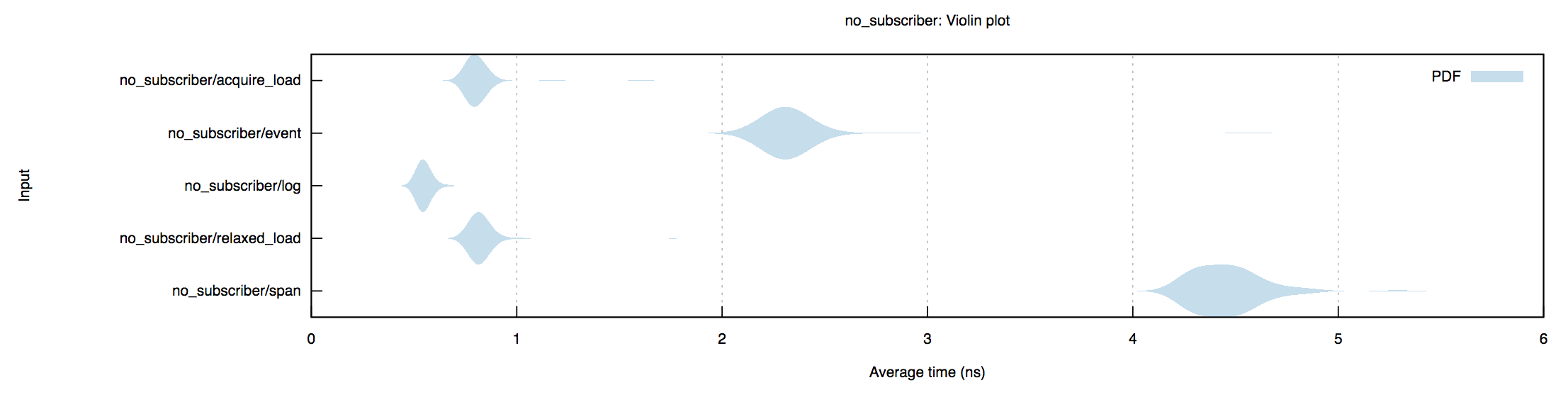 After: 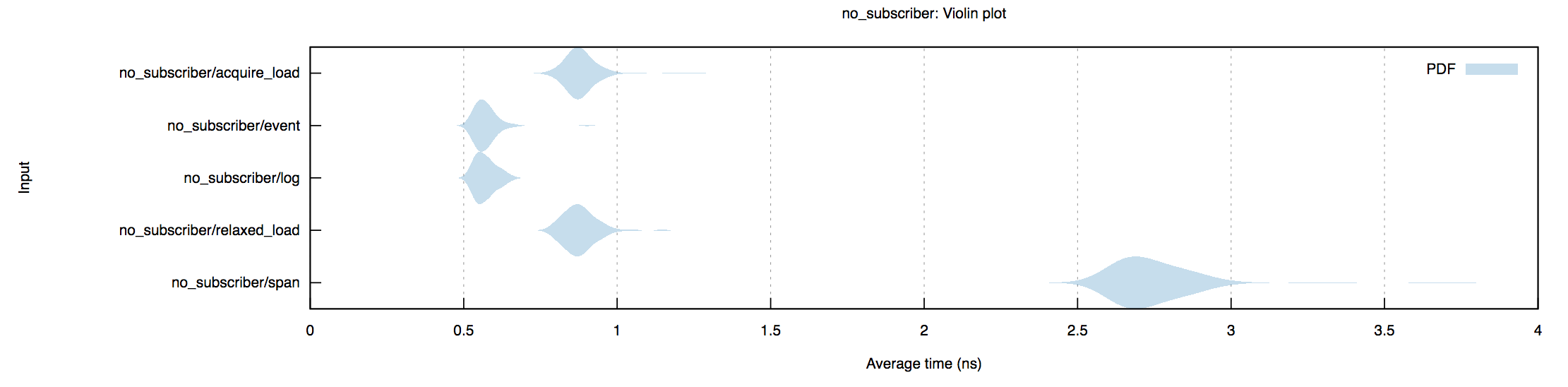 Note that when no subscriber is set, skipping an event previously took an average of around 2 ns, and skipping a span took around 5 ns. Now, skipping an event takes around 850 ps (about the same as skipping a `log` macro when there's no logger), while skipping a span macro takes around 2 ns. Signed-off-by: Eliza Weisman <eliza@buoyant.io> * tracing, core: improve no-subscriber performance significantly This branch adds a new private API to `tracing-core` for checking if a subscriber has ever been set. If a subscriber has never been set, we can elide almost all of the event macro, and more of the span macro than we were previously able to. Unlike checking a cached interest, which must synchronize with the callsite registry, checking if a subscriber has been set may be a relaxed rather than acquire load. The performance of the `event!` macro (and the related `trace!`, `info!`, etc macros) when no subscriber has ever been set (i.e., tracing is not being used) is now comparable with that of the `log` crate, at approximately 600 picoseconds (on my MacBook). As per `criterion`: ``` no_subscriber/event time: [610.43 ps 621.06 ps 633.20 ps] change: [-64.247% -62.295% -60.263%] (p = 0.00 < 0.05) Performance has improved. Found 4 outliers among 100 measurements (4.00%) 1 (1.00%) high mild 3 (3.00%) high severe no_subscriber/log time: [689.22 ps 707.34 ps 728.25 ps] change: [+27.149% +33.128% +40.141%] (p = 0.00 < 0.05) Performance has regressed. Found 4 outliers among 100 measurements (4.00%) 4 (4.00%) high mild no_subscriber_field/event time: [623.28 ps 635.73 ps 648.88 ps] change: [-59.666% -58.074% -56.649%] (p = 0.00 < 0.05) Performance has improved. Found 2 outliers among 100 measurements (2.00%) 2 (2.00%) high mild no_subscriber_field/log time: [621.73 ps 632.07 ps 643.30 ps] change: [+1.6194% +4.3288% +7.1454%] (p = 0.00 < 0.05) Performance has regressed. Found 3 outliers among 100 measurements (3.00%) 2 (2.00%) high mild 1 (1.00%) high severe ``` The worse performance of the `log` crate without fields than with fields is probably statistical noise that criterion failed to eliminate. The span macros cannot achieve this level of performance currently, as the callsite must still be constructed in order to emit `log` events when that feature flag is enabled. Future work will involve tuning the `span!` macro some more. However, performance is improved by this change. Signed-off-by: Eliza Weisman <eliza@buoyant.io> * optimize disabled spans when log support is off * tracing: add benchmarks for getting the subscriber Signed-off-by: Eliza Weisman <eliza@buoyant.io>

