 62ec04bbd5
8036: completions: provide relevance bonus for enum types, and suggest ref matches for fn and enum r=matklad a=JoshMcguigan This PR makes several improvements to completions and completion sorting: 1. Provide exact match type relevance score bonus for enum variants 2. Suggest `&Foo` (ref_match) for enums if that is an exact type match 3. Suggest `&foo()` (ref_match) if `foo` returns a type which would be an exact match either with the reference or due to a `Deref` impl ### Before 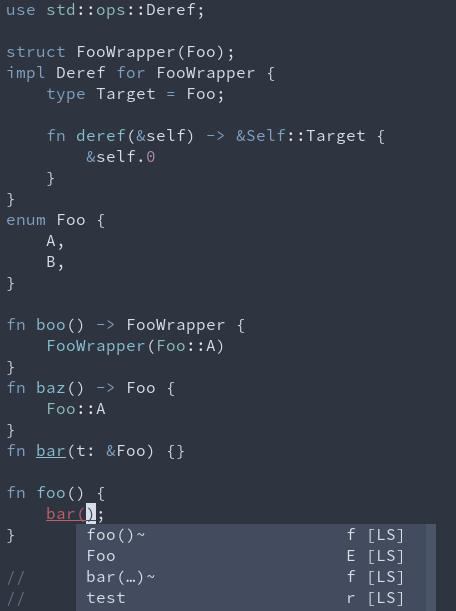 ### After 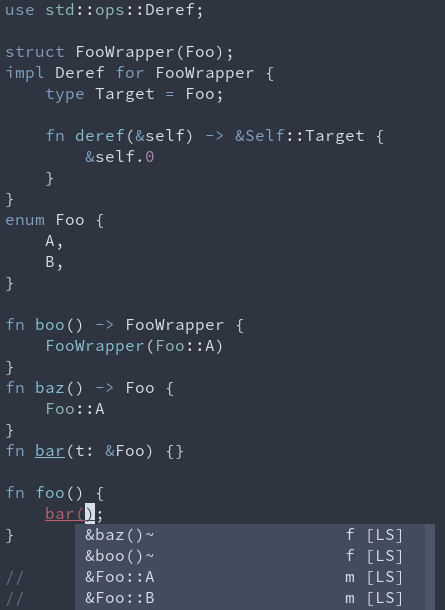 ### Caveats I think generic types will require some kind of fancier logic when testing for `exact_type_match`, so for now `Option`/`Result`/etc unfortunately still don't have great completions. ### Implementation I implemented this in a way that I think makes it most likely for each completion type to be handled consistently. Just replace `CompletionItem::new` with `CompletionItem::new_with_type_info` and `exact_type_match`/`exact_name_match`/`ref_match` are all handled for you, in a way which is sure to be consistent across completion types. This approach does introduce some coupling/plumbing that didn't exist before. Notice for example `set_is_local` on the builder, because `set_relevance` was removed from the builder to enforce that the relevance was built "properly" with `CompletionItem::new_with_type_info`. But I think there are benefits to this approach, like `CompletionRelevance` should probably consider deprecation status, and we already tell the builder about that, so in the (likely near term) future we can just pass that information along to `CompletionRelevance` when the user calls `set_deprecated` rather than the user having to manually set it in two places. This basically just hides `CompletionRelevance` from the individual completions, so they only worry about the `CompletionItem` interface. At the moment this seems like a cleaner approach to me, but I'm open to feedback here. edit - I've reimplemented this in a simpler way, per feedback below. 8046: Prefer match to if let else r=matklad a=matklad bors r+ 🤖 Co-authored-by: Josh Mcguigan <joshmcg88@gmail.com> Co-authored-by: Aleksey Kladov <aleksey.kladov@gmail.com>


rust-analyzer is an experimental modular compiler frontend for the Rust language. It is a part of a larger rls-2.0 effort to create excellent IDE support for Rust.
Work on rust-analyzer is sponsored by

Quick Start
https://rust-analyzer.github.io/manual.html#installation
Documentation
If you want to contribute to rust-analyzer or are just curious about how things work under the hood, check the ./docs/dev folder.
If you want to use rust-analyzer's language server with your editor of choice, check the manual folder. It also contains some tips & tricks to help you be more productive when using rust-analyzer.
Communication
For usage and troubleshooting requests, please use "IDEs and Editors" category of the Rust forum:
https://users.rust-lang.org/c/ide/14
For questions about development and implementation, join rls-2.0 working group on Zulip:
https://rust-lang.zulipchat.com/#narrow/stream/185405-t-compiler.2Frls-2.2E0
Quick Links
- Website: https://rust-analyzer.github.io/
- Metrics: https://rust-analyzer.github.io/metrics/
- API docs: https://rust-analyzer.github.io/rust-analyzer/ide/
- Changelog: https://rust-analyzer.github.io/thisweek
License
Rust analyzer is primarily distributed under the terms of both the MIT license and the Apache License (Version 2.0).
See LICENSE-APACHE and LICENSE-MIT for details.