## Motivation
The `time` crate must be compiled with `--cfg unsound_local_offset` in
order for local timestamps to be enabled. For users whose first exposure
to the `time` crate's API is via `tracing-subscriber`'s `time` timestamp
formatters, this is potentially _very_ surprising! Therefore, although
this cfg is not part of `tracing`'s API surface, we should probably
document this aspect of `time`'s API in the
`tracing-subscriber::fmt::time` documentation.
## Solution
This branch adds warnings in the `time::LocalTime` type's API docs, in
the struct-level documentation and on the `new` constructor, describing
that `--cfg unsound_local_offset` is necessary to record local
timestamps and referring users to the `time` documentation. I also added
`unsound_local_offset` to the `doc(cfg(...))` attributes for the
`LocalTime` type.
While I was changing `tracing-subscriber`'s docs, I also fixed a couple
formatting issues I noticed.
Fixes#1688
## Motivation

Currently, `tracing_subscriber::fmt` will bail out of formatting the log
line when formatting the timestamp fails. Previously, when timestamps
were formatted using the `chrono` crate, this was the correct behavior,
as getting the timestamp was infallible, and an error would only be
returned if *formatting* the timestamp to the buffer fails. This should
never actually happen, because we are writing the timestamp to a string,
which should never fail; using `?` is just a bit more efficient than
`.expect` because it doesn't require generating unwinding code.

However, this is no longer the case when using the `time` crate. In the
`time` API, actually getting a timestamp is fallible, and in some cases,
will fail. The current code will bail out of formatting the entire log
line if getting the timestamp fails, which is not great --- using the
wrong timestamp formatter will result in silently dropping all log
lines.

## Solution

This branch changes the `format_timestamp` method to print `<unknown
time>` when the timestamp formatting fails, rather than bailing. This
way, we at least print the rest of the log line for the event.

This fixes half of the issue described in #1688 (the other half is
improving documentation).
The line of code that prints the event's fields (including its message)
was accidentally deleted in 0a16972ba4,
while backporting PR #1696 from `master` (where the `Compact` formatter
implementation is significantly different).
This branch puts it back. Also, I've added tests for the `Compact` formatter's
output, to guard against accidentally breaking it in the future. Previously, we
only had tests for the `Full` and `Json` formatters.
Fixes#1741
Signed-off-by: Eliza Weisman <eliza@buoyant.io>
The test-env-log crate has been renamed to test-log to better reflect
its intent of not only catering to env_logger specific initialization
but also tracing (and potentially others in the future).
This change updates the documentation to reference test-log instead of
the now deprecated test-env-log.
## Motivation

Currently, `tracing_subscriber::fmt`'s `FmtContext` type is missing the
`span_scope`, `event_span`, and `event_scope` methods that `Context`
provides. This is a shame; these will make it much easier for users
implementing formatters to iterate over the scope of the event being
formatted correctly. We should expose those methods.

## Solution

This branch adds new methods to `FmtContext`, most of which forward to
the similarly-named `Context` methods. However, because a `FmtContext`
is only constructed when formatting an event, we can also make the event
scope methods a little more ergonomic by storing a ref to the span being
formatted and automatically passing it to `Context::event_scope` and
`Context::event_span`. This means the `FmtContext` can just always return
the current event's scope without the user having to pass it in.
This branch adds some documentation to the `FormatEvent` trait in
`tracing_subscriber::fmt` on how to write user-provided `FormatEvent`
implementations. There's probably room for additional improvement here,
but I just wanted to get something written down for now.

I also fixed a broken link I noticed while I was here.

Signed-off-by: Eliza Weisman <eliza@buoyant.io>
Co-authored-by: David Barsky <me@davidbarsky.com>
This branch adds some documentation to the `FormatEvent` trait in
`tracing_subscriber::fmt` on how to write user-provided `FormatEvent`
implementations. There's probably room for additional improvement here,
but I just wanted to get something written down for now.

I also fixed a broken link I noticed while I was here.

Signed-off-by: Eliza Weisman <eliza@buoyant.io>
Co-authored-by: David Barsky <me@davidbarsky.com>
Depends on #1696
## Motivation
PR #1696 adds a new API for propagating whether or not ANSI formatting
escape codes are enabled to the event formatter and field formatter via
the `Writer` type. This means that it's now quite easy to make field
formatting also include ANSI formatting escape codes when ANSI
formatting is enabled. Currently, `tracing-subscriber`'s default field
formatter does not use ANSI formatting --- ANSI escape codes are
currently only used for parts of the event log line controlled by the
event formatter, not within fields. Adding ANSI colors and formatting in
the fields could make the formatted output nicer looking and easier to
read.
## Solution
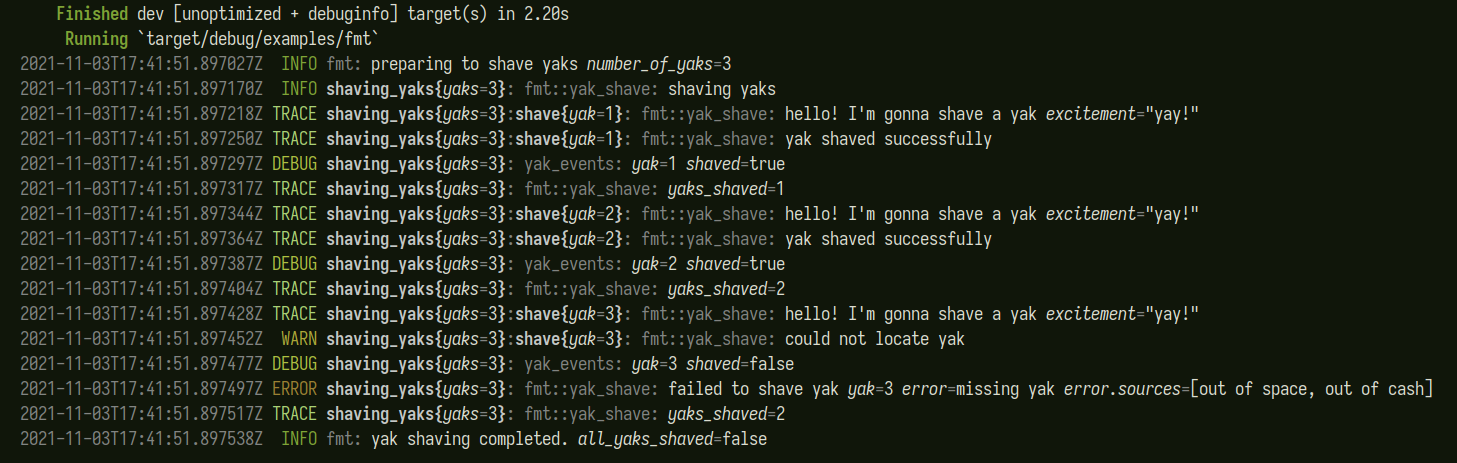
This branch adds support for ANSI formatting escapes in the default
field formatter, when ANSI formatting is enabled. Now, field names will
be italicized, and the `=` delimiter is dimmed. This should make it a
little easier to visually scan the field lists, since the names and
values are more clearly separated and should be easier to distinguish.
Additionally, I cleaned up the code for conditionally using ANSI
formatting significantly. Now, the `Writer` type has (crate-private)
methods for returning `Style`s for bold, dimmed, and italicized text,
when ANSI escapes are enabled, or no-op `Style`s when they are not. This
is reused in all the formatter implementations, so it makes sense to
have it in one place. I also added dimmed formatting of delimiters in a
couple other places in the default event format, which I thought
improved readability a bit by bringing the actual *text* to the
forefront.
Example of the default format with ANSI escapes enabled:
Signed-off-by: Eliza Weisman <eliza@buoyant.io>
This backports PR #1696 to v0.1.x.
## Motivation
Currently, whether `tracing-subscriber`'s `fmt` subscriber will ANSI
formatting escape codes use is configured on the `Format` type. This
means that the configuration is honored by the event formatters
implemented in `tracing-subscriber`, but is not easily exposed to those
in other crates. Additionally, it's not currently easy to expose the
configuration to the field formatter, so it's difficult to implement
field formatters that use ANSI escape codes conditionally.
Issue #1651 suggested a new API for this, where the writer that's passed
in to the event and field formatters provides a method for checking if
ANSI escape codes are supported.
## Solution
This branch adds a new method to the `Writer` type added in #1661. The
`FormatEvent` and `FormatFields` implementations can call
`Writer::has_ansi_escapes` to determine whether ANSI escape codes are
supported. This is also propagated to `FormattedFields`, so that it can
be determined when adding new fields to a preexisting set of formatted
fields.
Fixes#1651
Signed-off-by: Eliza Weisman <eliza@buoyant.io>
## Motivation
In `tracing-subscriber` 0.3.x, `MakeWriter` filtering seems to have
stopped working when using the `BoxMakeWriter` wrapper to erase the type
of a `MakeWriter` implementation. It looks like what happened is that
commit 6cc6c47354, which backported the
change to add a lifetime parameter to `MakeWriter` (#781), I
accidentally clobbered the `make_writer_for` method on the inner `Boxed`
type, so that it only has `make_writer`:
6cc6c47354 (diff-c5dc275b15a60c1a2d4694da3797f4247c4f2e1e0978fd210dd14452d6746283L737-L739)
This meant that any filtering performed by the `MakeWriter` inside the
box is now ignored. My bad!
## Solution
This commit puts back the missing `make_writer_for` method. Whoops!
Fixes#1694
Resolves#1669. Namely, I:
- fixed the incorrect docs on `LevelFilter`.
- Removed a stray backtick on `LevelFilter::current`.
- Added a matching backtick in Level's documentation.
I did _not_ add example of comparing a level against a `LevelFilter`; I
instead pointed readers to Level's documentation.
# 0.3.1 (Oct 25, 2021)

This release fixes a few issues related to feature flagging.

### Fixed

- **time**: Compilation error when enabling the "time" feature flag
  without also enabling the "local-time" feature flag ([#1685])
- **registry**: Unused method warnings when the "std" feature is enabled
  but the "registry" feature is disabled ([#1686])

[#1685]: https://github.com/tokio-rs/tracing/pull/1685
[#1686]: https://github.com/tokio-rs/tracing/pull/1686
## Motivation

Currently, there are some `pub(crate)` methods on the `Extensions`,
`ExtensionsMut`, and `ExtensionsInner` types that are only used when the
"registry" feature is enabled. However, the _types_ exist when the "std"
feature flag is enabled, so those methods produce unused method
warnings.

## Solution

This commit adds `#[cfg(feature = "registry")]` to those methods, fixing
the warning.
## Motivation
Currently, the `pub use` re-export for the `LocalTime` struct is enabled
whenever the "time" feature flag is enabled. However, this type only
_exists_ when the "local-time" feature flag is enabled, so enabling only
the `time` feature results in a compilation error.
## Solution
This commit adds a separate `pub use` for `LocalTime` that's only
enabled when the "local-time" feature is enabled.
Fixes#1683
# 0.2.0 (October 22, 2021)

This breaking change release adds support for the new v0.3.x series of
`tracing-subscriber`. In addition, it resolves the security advisory for
the `chrono` crate, [RUSTSEC-2020-0159].

This release increases the minimum supported Rust version (MSRV) to
1.51.0.
### Breaking Changes

- Updated `tracing-subscriber` to v0.3.x ([#1677])
- Changed `NonBlocking::error_counter` to return an `ErrorCounter` type,
  rather than an `Arc<AtomicU64>` ([#1675])
  ### Changed

- Updated `tracing-subscriber` to v0.3.x ([#1677])
  ### Fixed

- **non-blocking**: Fixed compilation on 32-bit targets ([#1675])
- **rolling**: Replaced `chrono` dependency with `time` to resolve
  [RUSTSEC-2020-0159] ([#1652])
- **rolling**: Fixed an issue where `RollingFileAppender` would fail to
  print errors that occurred while flushing a previous logfile ([#1604])

Thanks to new contributors @dzvon and @zvkemp for contributing to this
release!

[RUSTSEC-2020-0159]: https://rustsec.org/advisories/RUSTSEC-2020-0159.html
[#1677]: https://github.com/tokio-rs/tracing/pull/1677
[#1675]: https://github.com/tokio-rs/tracing/pull/1675
[#1652]: https://github.com/tokio-rs/tracing/pull/1675
[#1604]: https://github.com/tokio-rs/tracing/pull/1604
# 0.3.0 (Oct 22, 2021)

This is a breaking release of `tracing-subscriber`. The primary breaking
change in this release is the removal of the dependency on the [`chrono`
crate], due to [RUSTSEC-2020-0159]. To replace `chrono`, support is
added for formatting timestamps using the [`time` crate] instead.

In addition, this release includes a number of other breaking API
changes, such as adding (limited) support for `#![no_std]` targets,
removing previously deprecated APIs, and more.

### Breaking Changes

- Removed APIs deprecated in the v0.2.x release series.
- Renamed `Layer::new_span` to `Layer::on_new_span` ([#1674])
- Removed `Layer` impl for `Arc<L: Layer<S>>` and `Arc<dyn Layer<S> +
  ...>` ([#1649])
- Replaced the [`chrono` crate] with the [`time` crate] for timestamp
  formatting, to resolve [RUSTSEC-2020-0159] ([#1646])
- Removed `json` and `env-filter` from default features. They must now
  be enabled explictly ([#1647])
- Changed `FormatEvent::format_event` and `FormatFields::format_fields`
  trait methods to take a `Writer` type, rather than a `&mut dyn
  fmt::Write` trait object ([#1661])
- Changed the signature of the `MakeWriter` trait by adding a lifetime
  parameter ([#781])
  ### Changed

- **layer**: Renamed `Layer::new_span` to `Layer::on_new_span` ([#1674])
- **fmt**: Changed `FormatEvent::format_event` and
  `FormatFields::format_fields` trait methods to take a `Writer` type,
  rather than a `&mut dyn fmt::Write` trait object ([#1661])
- **json**, **env-filter**: `json` and `env-filter` feature flags are no
  longer enabled by default ([#1647])
  ### Removed

- Removed deprecated `CurrentSpan` type ([#1320])
- **registry**: Removed deprecated `SpanRef::parents` iterator, replaced
  by `SpanRef::scope` in [#1431] ([#1648)])
- **layer**: Removed deprecated `Context::scope` iterator, replaced by
  `Context::span_scope` and `Context::event_scope` in [#1431] and
  [#1434] ([#1648)])
- **layer**: Removed `Layer` impl for `Arc<L: Layer<S>>` and `Arc<dyn
  Layer<S> + ...>`. These interfere with per-layer filtering. ([#1649])
- **fmt**: Removed deprecated `LayerBuilder` type ([#1673])
- **fmt**: Removed `fmt::Layer::on_event` (renamed to
  `fmt::Layer::fmt_event`) ([#1673])
- **fmt**, **chrono**: Removed the `chrono` feature flag and APIs for
  using the [`chrono` crate] for timestamp formatting ([#1646])
  ### Added

- **fmt**, **time**: `LocalTime` and `UtcTime` types for formatting
  timestamps using the [`time` crate] ([#1646])
- **fmt**: Added a lifetime parameter to the `MakeWriter` trait,
  allowing it to return a borrowed writer. This enables implementations
  of `MakeWriter` for types such as `Mutex<T: io::Write>` and
  `std::fs::File`. ([#781])
- **env-filter**: Documentation improvements ([#1637])
- Support for some APIs on `#![no_std]` targets, by disabling the `std`
  feature flag ([#1660])

Thanks to @Folyd and @nmathewson for contributing to this release!

[#1320]: https://github.com/tokio-rs/tracing/pull/1320
[#1673]: https://github.com/tokio-rs/tracing/pull/1673
[#1674]: https://github.com/tokio-rs/tracing/pull/1674
[#1646]: https://github.com/tokio-rs/tracing/pull/1646
[#1647]: https://github.com/tokio-rs/tracing/pull/1647
[#1648]: https://github.com/tokio-rs/tracing/pull/1648
[#1649]: https://github.com/tokio-rs/tracing/pull/1649
[#1660]: https://github.com/tokio-rs/tracing/pull/1660
[#1661]: https://github.com/tokio-rs/tracing/pull/1661
[#1431]: https://github.com/tokio-rs/tracing/pull/1431
[#1434]: https://github.com/tokio-rs/tracing/pull/1434
[#781]: https://github.com/tokio-rs/tracing/pull/781

[`chrono` crate]: https://crates.io/crates/chrono
[`time` crate]: https://crates.io/crates/time
[RUSTSEC-2020-0159]: https://rustsec.org/advisories/RUSTSEC-2020-0159.html

Signed-off-by: Eliza Weisman <eliza@buoyant.io>
This branch is @dzvon's PR #1508, with the following changes:
* Add a newtype wrapping the error counter to hide that it's internally
an `Arc<AtomicUsize>`. This would allow us to make additional changes
to the implementation without potentially causing breaking changes.
* Use saturating arithmetic when incrementing the counter to avoid
wrapping to 0 on overflows. This is more likely to be an issue on
32-bit platforms.
This is a breaking change that will be released as part of
`tracing-appender` 0.2.
Closes#1508
Description from @dzvon's original PR:
## Motivation
Currently, tracing-appender crate cannot be compiled on PowerPC
platform. Because
> PowerPC and MIPS platforms with 32-bit pointers do not have
> `AtomicU64` or `AtomicI64` types.
quote from std library docs.
(https://doc.rust-lang.org/std/sync/atomic/index.html#portability)
## Solution
Change `AtomicU64` to `AtomicUsize`.
Co-authored-by: Dezhi Wu <wu543065657@163.com>
## Motivation

This PR continues the work started in
https://github.com/tokio-rs/tracing/pull/1646 to replace `chrono` with
`time`. I'll refer to @hawkw's motivation:

> Currently, `tracing-subscriber` supports the `chrono` crate for
> timestamp formatting, via a default-on feature flag. When this code
> was initially added to `tracing-subscriber`, the `time` crate did not
> have support for the timestamp formatting options we needed.
>
> Unfortunately, the `chrono` crate's maintenance status is now in
> question (see #1598). Furthermore, `chrono` depends on version 0.1 of
> the `time` crate, which contains a security vulnerability
> (https://rustsec.org/advisories/RUSTSEC-2020-0071.html). This
> vulnerability is fixed in more recent releases of `time`, but `chrono`
> still uses v0.1.

## Solution

I've replaced chrono with time 0.3. Unfortunately, some of chrono's
builders for DateTimes are not present in `time`, which required the
usage of `macro_rules!` macros to construct some of the hard-coded
times. I also took the opportunity to tidy some of the tests and change
the internal representation of `Rotation::NEVER` from year 9,999 to an
`Option::None`.

This branch changes `tracing-appender`'s MSRV from Rust 1.42 to Rust
1.51, the MSRV for the `time` crate when certain required feature flags
are enabled. This does *not* effect the MSRV for other crates in this
repository.
This branch adds some environment variables to configure *all* CI jobs.
In particular, we:

- disable incremental compilation
- increase the number of retries for network requests in `cargo` and
  `rustup`
- emit shortened backtraces from panics

This config was blatantly stolen from linkerd/linkerd2-proxy#7137. :)

Incremental compilation is useful as part of an edit-build-test-edit
cycle, as it lets the compiler avoid recompiling code that hasn't
changed. However, on CI, we're not making small edits; we're almost
always building the entire project from scratch. Thus, incremental
compilation on CI actually introduces *additional* overhead to support
making future builds faster...but no future builds will ever occur in
any given CI environment.

See https://matklad.github.io/2021/09/04/fast-rust-builds.html#ci-workflow
for details.

Increasing retries for network requests should help reduce flakiness a
bit.
## Motivation

Currently, `tracing-attributes` consists of one very large `lib.rs`
module that's 1358 lines long. In my opinion, this makes the code
somewhat hard to navigate.

## Solution

This branch refactors `tracing-attributes` so that most of the code is
split into two separate modules: `attrs.rs`, which contains the types
representing the attribute arguments and the code for parsing them, and
`expand.rs`, which contains the code for actually expanding an
`#[instrument]` macro to generate the instrumented code. For the most
part, this was a pretty clean split.

I also did a small change to the way `async-trait` support is
implemented; moving the two steps for generating instrumented code for
`async-trait` to two methods on the `AsyncTraitInfo` struct; one for
determining if the instrumented function is also an `async-trait` method
and finding the necessary information to instrument it, and one for
generating the instrumented code. This feels a bit neater than doing all
of that in the `gen_function` function.

There shouldn't be any functional changes or significant
implementatation changes (besides the `async-trait` change) in this
branch; just moving code around.

Signed-off-by: Eliza Weisman <eliza@buoyant.io>
## Motivation
Recent `rust-analyzer` versions enabled automatic expansion of proc
macro attributes by default. This is a problem with `#[instrument]`,
because it currently produces a `compile_error!` when parsing the code
inside the `#[instrument]`ed function fails, and *discards* those
tokens. This means that if the `#[instrument]` attribute is placed on a
function whose implementation fails to parse, recent versions of
`rust-analyzer` will no longer be able to display diagnostics for those
errors. In some cases, this can also break autocompletion.
## Solution
This branch changes `#[instrument]` to always expand to the tokens
contained in the `#[instrument]`ed function body, regardless of whether
or not they could be parsed successfully. Now, an error is only emitted
when the `#[instrument]` attribute *itself* could not be parsed. Since
the instrumented function is always expanded, any errors within that
function can be displayed properly by `rust-analyzer`.
Fixes#1633.
## Motivation

This PR attempts to solve #1630 by introducing `err(Debug)` meta to
`intrument` attribute macro. As `err` meta causes the error (`e`)
returned by instrumented function to be passed to `tracing::error!(error
= %e)` i.e. makes it use the `Display` implementation of `e`, the newly
added `err(Debug)` makes expands to `tracing::error!(error = ?e)` which
makes the `error!` macro to use `Debug` implementation for `e`. `err`
and `err(Debug)` are mutually exclusive, adding both will create a
compilation error.

`err(Display)` is also supported to specify `Display` explicitly.

As tried to describe, for some types implementing `Error` it might be
more suitable to use `Debug` implementation as in the case of
`eyre::Result`. This frees us to manually go over the error chain and
print them all, so that `instrument` attribute macro would do it for us.

## Solution

- Added a custom keyword `err(Debug)` similar to `err`,
- Add `err(Debug)` field to `InstrumentArgs`,
- Add parsing for `err(Debug)` arg and check for conflicts with `err`,
- Generate `tracing::error!(error = ?e)` when `err(Debug)` is `true` and
  `tracing::error!(error = %e)` when `err(Display)` or `err` is `true`,
- Interpolate generated `err_block` into `Err` branches in both async
  and sync return positions, if `err` or `err(Debug)` is `true`.
## Motivation

`tracing-subscriber` currently contains some APIs that were deprecated
in the v0.2.x series:
- `fmt::LayerBuilder`, which is now a type alias for `fmt::Layer` (as
  the `Layer` type can expose all the same methods as the builder)
- `registry::SpanRef::parent_id`, which doesn't play nice with per-layer
  filtering,
- `fmt::Layer::inherit_fields`, which no longer does anything as it's
  now the default behavior
- `fmt::Layer::on_event`, which was renamed to `fmt_event`
- the `SpanRef::parents` and `layer::Context::scope` iterators, which
  were replaced by the APIs added in #1431 and #1434

Prior to releasing v0.3, the deprecated APIs should be removed.

## Solution

This branch deletes the deprecated APIs, with the exception of
`SpanRef::parents` and `Context::scope` (which were already removed in
240d11a7ef).

Signed-off-by: Eliza Weisman <eliza@buoyant.io>
Turns out that if `std` is enabled but `smallvec` is not, we have some
missing imports. This fixes the build when a crate passes
`default-features = "false` but then enables `std`.

Signed-off-by: Eliza Weisman <eliza@buoyant.io>
## Motivation

Currently, `cargo audit` checks are run on every push that modifies
`Cargo.toml` or lockfiles. The intention behind this was to fail changes
that introduce dependencies that have security advisories. However, it
turns out that this is not actually the primary use-case for `cargo audit`
runs. Typically, when a dependency of a `tracing` crate has a
security advisory, this isn't newly introduced by a PR, but a new
*advisory* that was just announced for a library we *already* depended
on. In this case, this isn't a failure that should block any particular
branch from merging; instead, it's a *new issue* that should block
effected crates from being *released*.

## Solution

This branch changes the audit workflow from running on pushes to running
on a schedule (nightly). When using `actions-rs/audit-check` in a
scheduled mode, it will automatically open new issues if any
dependencies have security advisories (see
https://github.com/actions-rs/audit-check#scheduled-audit for details).
This means those advisories can be fixed separately while still allowing
unrelated branches to pass CI. This is, IMO, a better workflow for
handling security advisories.

If we introduce release automation in the future, we should ensure that
the release automation process checks that the crate being released has
no open security advisory issues, and fails the *release* if any such
issues are still open.
## Motivation

Currently, the `FormatEvent` and `FormatFields` traits in
`tracing-subscriber` are passed a `&mut dyn fmt::Write` trait object to
write formatted representations of events and fields to. This is fine,
but it doesn't give us the ability to easily provide additional
configuration to the formatter, such as whether ANSI color codes are
supported.

Issue #1651 describes some approaches for adding a way to expose the
ANSI color code configuration to custom formatters. In particular, the
proposed solution involves wrapping the `fmt::Write` trait object in an
opaque struct, which can then implement additional methods for exposing
information like "are ANSI colors enabled" to the formatter. Since this
changes the signature of the `FormatEvent::format_event` and
`FormatFields::format_fields` methods, it's a breaking change.
Therefore, we need to make this change _now_ if we want to get the API
change in for `tracing-subscriber` 0.3.

## Solution

This branch adds a `Writer` struct that wraps the `&mut dyn fmt::Write`
trait object, and changes the various method signatures as appropriate.
It does **not** actually implement the change related to ANSI color
formatting. Once we change these methods' signatures to accept a
`Writer` struct, we can add as many methods to that struct as we like
without making additional breaking API changes. Therefore, this branch
_just_ makes the breaking change that's necessary to get in before v0.3
is released.

Propagating the ANSI color configuration can be implemented in a future
branch.

Signed-off-by: Eliza Weisman <eliza@buoyant.io>
## Motivation

Currently, some `tracing-subscriber` dependencies in other crates use
`default-features = false`, to ensure that unneeded default features of
`tracing-subscriber` are not inadvertently enabled. However, some of the
features those crates enable also require the `std` feature flag. The
`default-features = false` config _disables_ the `std` feature, so the
required features are not available.

## Solution

This branch changes `tracing-subscriber`'s `fmt`, `registry`, and
`env-filter` feature flags to also enable the `std` feature flag
automatically.

## Alternatives

As an alternative solution, we could change crates that depend on
`tracing-subscriber` with `default-features = false` to also explicitly
ensure that the `std` feature is enabled (which might be worth doing
regardless). This is what PR #1659 does. However, I think the approach
in this branch is more correct; the feature flags that require standard
library support should automatically enable it. This provides a better
experience for most users, who are simply adding `default-features = false`
in order to avoid enabling un-needed features, not to support
`no_std`, and would like enabling a feature flag to *actually* enable
that feature.

`no_std` users will know not to enable `registry`, `fmt`, and
`env-filter` because the documentation notes that those features require
the standard library.
Backports #1648 from `master`.
Depends on #1649
## Motivation
Presently, the `tracing-subscriber` crate requires the Rust standard
library and doesn't build with `#![no_std]` targets. For the most part,
this is fine, as much of `tracing-subscriber` inherently depends on
`std` APIs.
However, `tracing-subscriber` also contains some key abstractions that
are necessary for interoperability: the `Layer` and `LookupSpan`
traits. Since these traits are in `tracing-subscriber`, `no-std` users
cannot currently access them.
Some of the other utilities in this crate, such as the field visitor
combinators, may also be useful for `#![no_std]` projects.
## Solution
This branch adds "std" and "alloc" feature flags to
`tracing-subscriber`, for conditionally enabling `libstd` and
`liballoc`, respectively. The `registry`, `fmt`, `EnvFilter`, and
`reload` APIs all require libstd, and cannot be implemented without it,
but the core `Layer` and `LookupSpan` traits are now available with
`#![no_std]`.
Fixes#999
Signed-off-by: Eliza Weisman <eliza@buoyant.io>
Implementing `Layer` for `Arc`s, which are immutable, breaks the
ability to implement `Layer::on_layer` with a mutable reference.
This is necessary for per-layer filtering. See
https://github.com/tokio-rs/tracing/pull/1576#discussion_r711609810 for
details. Therefore, the `Layer` impls for `Arc`s should not be used.

In 0.3, we have the opportunity to remove these APIs. Therefore, this PR
removes them.
This changes `tracing-subscriber` so that the `env-filter`, `json`,
and `chrono` features are not enabled by default, and instead require
users to opt in. This should significantly reduce the default
dependency footprint.
Of course, this is a breaking change, and therefore will be part of
`tracing-subscriber` v0.3.
Fixes#1258
Signed-off-by: Eliza Weisman <eliza@buoyant.io>
## Motivation
Currently, `tracing-subscriber` supports the `chrono` crate for
timestamp formatting, via a default-on feature flag. When this code was
initially added to `tracing-subscriber`, the `time` crate did not have
support for the timestamp formatting options we needed.
Unfortunately, the `chrono` crate's maintainance status is now in
question (see #1598). Furthermore, `chrono` depends on version 0.1 of
the `time` crate, which contains a security vulnerability
(https://rustsec.org/advisories/RUSTSEC-2020-0071.html). This
vulnerability is fixed in more recent releases of `time`, but `chrono`
still uses v0.1.
## Solution
Fortunately, the `time` crate now has its own timestamp formatting
support.
This branch replaces the `ChronoLocal` and `ChronoUtc` timestamp
formatters with new `LocalTime` and `UtcTime` formatters. These
formatters use the `time` crate's formatting APIs rather than
`chrono`'s. This removes the vulnerable dependency on `time` 0.1
Additionally, the new `time` APIs are feature flagged as an _opt-in_
feature, rather than as an _opt-out_ feature. This should make it easier
to avoid accidentally depending on the `time` crate when more
sophisticated timestamp formatting is _not_ required.
In a follow-up branch, we could also add support for `humantime` as an
option for timestamp formatting.
Naturally, since this removes existing APIs, this is a breaking change,
and will thus require publishing `tracing-subscriber` 0.3. We'll want to
do some other breaking changes as well.
Fixes#1598.