 c0c61d1cf4
## Motivation When `tracing` is not in use, no default subscriber will be set, and tracing instrumentation points can be skipped. Currently, the instrumentation macros detect this by testing if the callsite's `Interest` is `never`. However, this is significantly slower than how the `log` crate detects that there is no logger: we must call a function through a trait object, do a relaxed load, construct an `Interest` from an integer, and then test on the value of the `Interest`. Furthermore, we must construct the callsite _at all_ in order to do this. Meanwhile, when no logger is set, `log` can skip log records with only a single relaxed atomic load. ## Solution This branch adds a new private-API method in `tracing_core::dispatcher` that allows us to check if a dispatcher has ever been set. If this is false, then `tracing` has not yet been initialized and the callsite can be elided entirely. Representing this as an atomic bool lets us perform a single relaxed load and branch, without having to mess around with `Interest`s and callsite vtables and so on. In cases where `tracing` will never be used, this will always be false. This the event macro performance with no subscriber set on par with the `log` crate's performance when no logger is set. Spans are a bit slower because they must still construct a disabled span object, but the span macros are somewhat faster in this case than they were previously. ## Benchmark results Before: 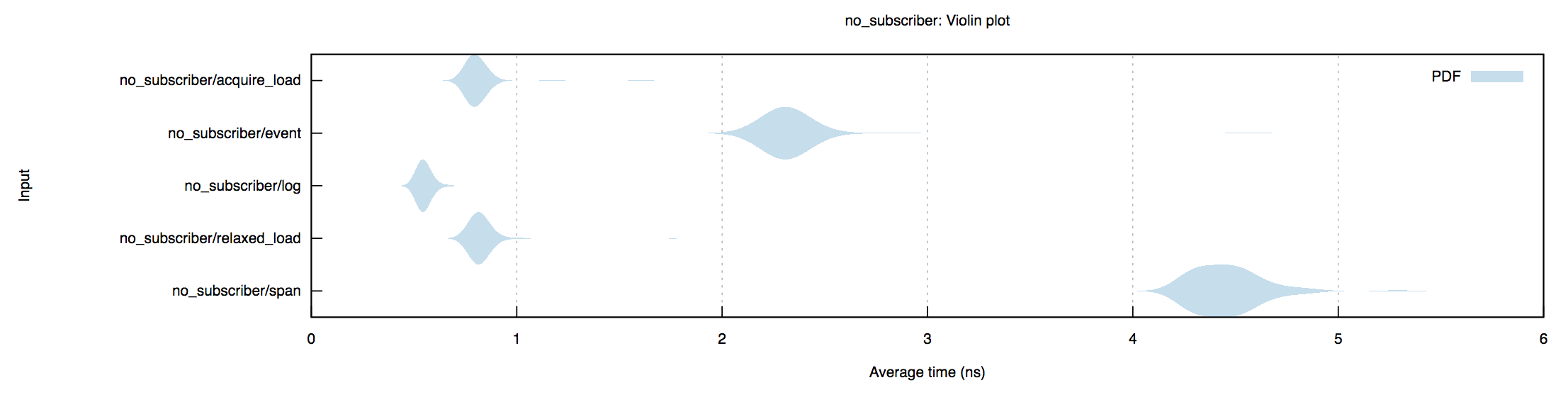 After: 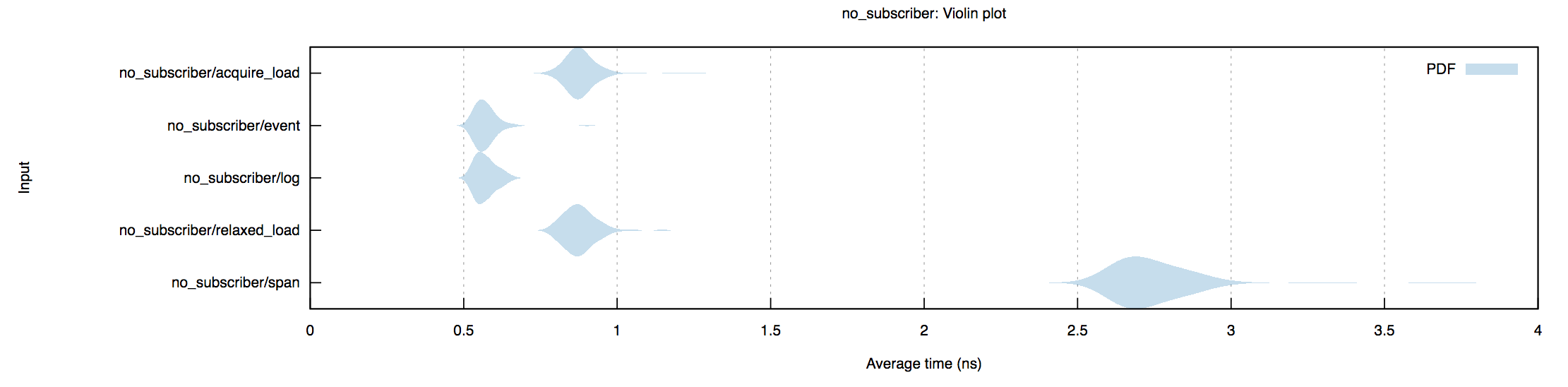 Note that when no subscriber is set, skipping an event previously took an average of around 2 ns, and skipping a span took around 5 ns. Now, skipping an event takes around 850 ps (about the same as skipping a `log` macro when there's no logger), while skipping a span macro takes around 2 ns. Signed-off-by: Eliza Weisman <eliza@buoyant.io> * tracing, core: improve no-subscriber performance significantly This branch adds a new private API to `tracing-core` for checking if a subscriber has ever been set. If a subscriber has never been set, we can elide almost all of the event macro, and more of the span macro than we were previously able to. Unlike checking a cached interest, which must synchronize with the callsite registry, checking if a subscriber has been set may be a relaxed rather than acquire load. The performance of the `event!` macro (and the related `trace!`, `info!`, etc macros) when no subscriber has ever been set (i.e., tracing is not being used) is now comparable with that of the `log` crate, at approximately 600 picoseconds (on my MacBook). As per `criterion`: ``` no_subscriber/event time: [610.43 ps 621.06 ps 633.20 ps] change: [-64.247% -62.295% -60.263%] (p = 0.00 < 0.05) Performance has improved. Found 4 outliers among 100 measurements (4.00%) 1 (1.00%) high mild 3 (3.00%) high severe no_subscriber/log time: [689.22 ps 707.34 ps 728.25 ps] change: [+27.149% +33.128% +40.141%] (p = 0.00 < 0.05) Performance has regressed. Found 4 outliers among 100 measurements (4.00%) 4 (4.00%) high mild no_subscriber_field/event time: [623.28 ps 635.73 ps 648.88 ps] change: [-59.666% -58.074% -56.649%] (p = 0.00 < 0.05) Performance has improved. Found 2 outliers among 100 measurements (2.00%) 2 (2.00%) high mild no_subscriber_field/log time: [621.73 ps 632.07 ps 643.30 ps] change: [+1.6194% +4.3288% +7.1454%] (p = 0.00 < 0.05) Performance has regressed. Found 3 outliers among 100 measurements (3.00%) 2 (2.00%) high mild 1 (1.00%) high severe ``` The worse performance of the `log` crate without fields than with fields is probably statistical noise that criterion failed to eliminate. The span macros cannot achieve this level of performance currently, as the callsite must still be constructed in order to emit `log` events when that feature flag is enabled. Future work will involve tuning the `span!` macro some more. However, performance is improved by this change. Signed-off-by: Eliza Weisman <eliza@buoyant.io> * optimize disabled spans when log support is off * tracing: add benchmarks for getting the subscriber Signed-off-by: Eliza Weisman <eliza@buoyant.io>


tracing
Application-level tracing for Rust.



Website | Chat | Documentation (master branch)
Overview
tracing is a framework for instrumenting Rust programs to collect
structured, event-based diagnostic information. tracing is maintained by the
Tokio project, but does not require the tokio runtime to be used.
Getting Help
First, see if the answer to your question can be found in the API documentation. If the answer is not there, there is an active community in the Tracing Gitter channel. We would be happy to try to answer your question. Last, if that doesn't work, try opening an issue with the question.
Contributing
🎈 Thanks for your help improving the project! We are so happy to have you! We have a contributing guide to help you get involved in the Tracing project.
Project layout
The tracing crate contains the primary instrumentation API, used for
instrumenting libraries and applications to emit trace data. The tracing-core
crate contains the core API primitives on which the rest of tracing is
instrumented. Authors of trace subscribers may depend on tracing-core, which
guarantees a higher level of stability.
Additionally, this repository contains several compatibility and utility
libraries built on top of tracing. Some of these crates are in a pre-release
state, and are less stable than the tracing and tracing-core crates.
The crates included as part of Tracing are:
-
tracing-futures: Utilities for instrumentingfutures. (crates.io|docs) -
tracing-macros: Experimental macros for emitting trace events (unstable). -
tracing-attributes: Procedural macro attributes for automatically instrumenting functions. (crates.io|docs) -
tracing-log: Compatibility with thelogcrate (unstable). -
tracing-serde: A compatibility layer for serializing trace data withserde(unstable). -
tracing-subscriber: Subscriber implementations, and utilities for implementing and composingSubscribers. (crates.io|docs) -
tracing-tower: Compatibility with thetowerecosystem (unstable).
External Resources
This is a list of links to blog posts, conference talks, and tutorials about Tracing.
Blog Posts
- Diagnostics with Tracing on the Tokio blog, August 2019
Talks
- Bay Area Rust Meetup talk and Q&A, March 2018
Help us expand this list! If you've written or spoken about Tracing, or know of resources that aren't listed, please open a pull request adding them.
License
This project is licensed under the MIT license.
Contribution
Unless you explicitly state otherwise, any contribution intentionally submitted for inclusion in Tracing by you, shall be licensed as MIT, without any additional terms or conditions.